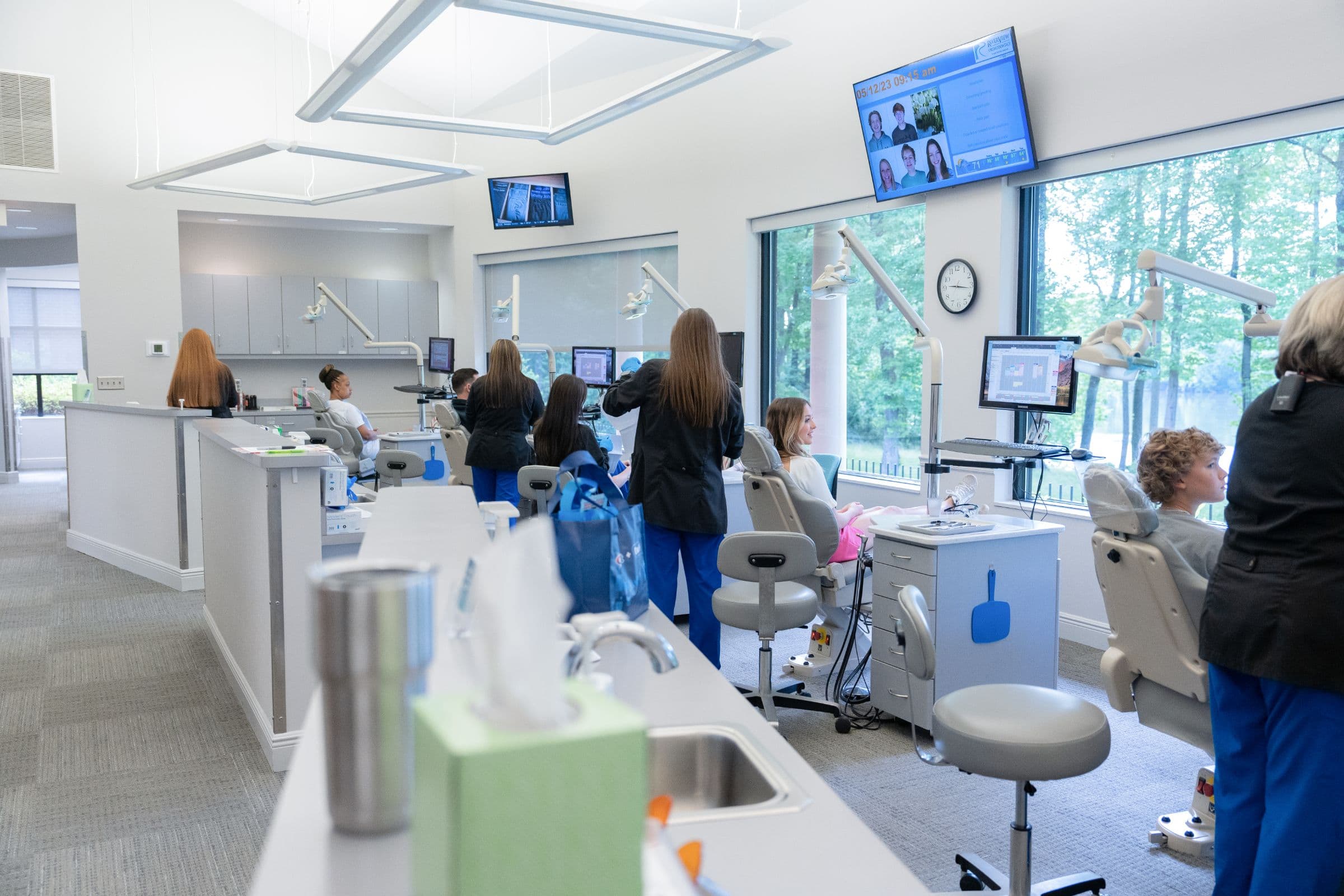
What is in-house 3D printing in orthodontics? It’s a digital workflow where your teeth are scanned with a handheld camera, your case is designed on computer software inside the practice, and models or appliances are printed on site with a resin 3D printer. No putty impressions. No shipping to an outside lab.
Families at RiverView Orthodontics ask about this often, usually after seeing a scanner wand in a video or hearing a friend mention a same-day retainer. The short answer is that the lab work moves into the building instead of across the state.
The workflow has three parts:
- An intraoral scanner captures a detailed 3D map of your teeth, gums, and bite in minutes.
- Treatment planning software lets Dr. Upton design tooth movement, trim the model, and build the appliance digitally.
- A resin 3D printer turns that digital design into a physical object, one thin layer at a time.
Compare that to the traditional route. You bite into a tray of impression material, wait several minutes for it to set, and then the practice boxes up your impressions for shipping. From there, the trip is a long one: your impressions travel to an outside lab, wait in a queue behind other cases, get worked on, and travel back. Weeks pass before anything reaches your mouth.
What Can a Practice 3D Print?
Most practices with a printer produce a similar set of items:
- Models used to form clear aligners
- Retainers and retainer models
- Indirect bonding trays that position brackets precisely
- Expanders and other growth-guiding treatment options
- Splints for jaw joint concerns
- Planning guides for jaw-related cases
One clarification that surprises a lot of people: the aligners themselves usually aren’t printed. A printer builds an exact model of your teeth, then a clear sheet of plastic is heated and formed over that model, trimmed, and polished. Directly printed aligners exist, though the model-and-thermoform method remains the standard in most practices today. The same is true for most retainers, which start life as a printed replica of your finished bite before the clear material is ever pulled over them.
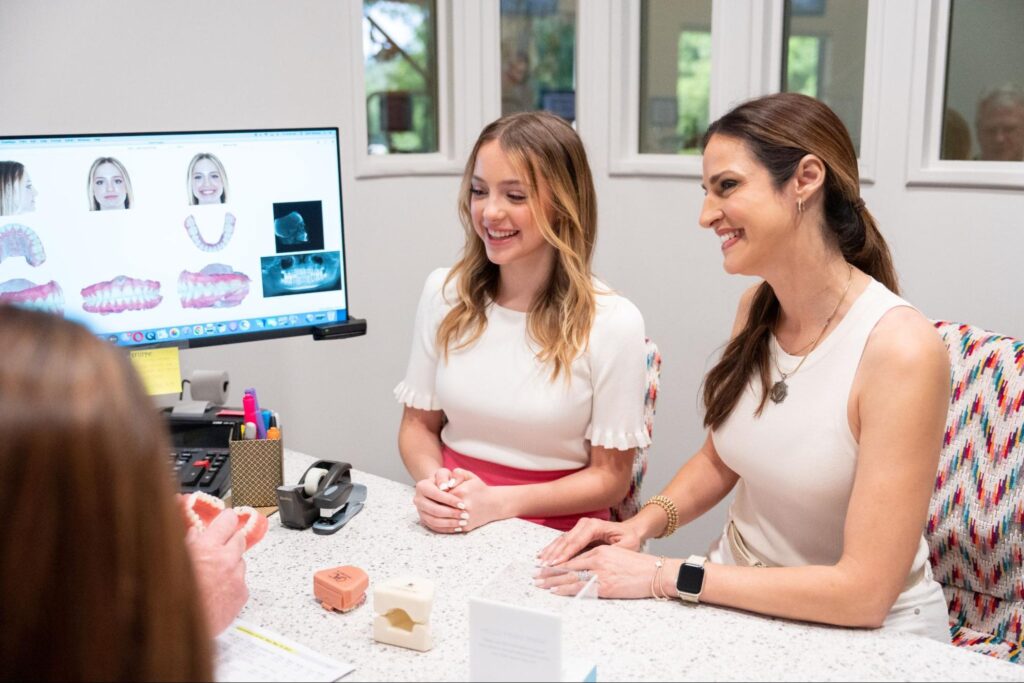
How In-House 3D Printing Works, Step by Step
In-house 3D printing follows five steps: a digital scan of your teeth, a designed treatment plan in software, layer-by-layer printing in resin, post-processing that washes and cures the print, then a fit check and delivery. Routine items are often finished within the same visit or a few days rather than weeks.
Step 1: What Happens During the Digital Scan?
A small wand glides over your teeth while a screen builds your smile in 3D. Most scans take somewhere in the 3-8 minute range, depending on the case and how much detail is needed. Nothing sets in your mouth. Nothing tastes like clay.
Step 2: How Is Your Case Designed and Planned?
Your scan uploads into planning software, where individual teeth are separated from the model and the target positions get mapped out. This is where clinical judgment matters most. Software suggests movements, but Dr. Upton decides what your bite actually needs.
Step 3: How Does the Printing Actually Work?
The printer builds your model or appliance from liquid photopolymer resin, curing each layer with light before adding the next. Three printer styles show up most often in orthodontic practices:
| Printer Type | How It Cures | Common Use |
|---|---|---|
| DLP (Digital Light Processing) | Projector cures a full layer at once | Aligner models, bonding trays |
| LCD / MSLA | LCD screen masks light per layer | Models, retainers, high-volume printing |
| SLA (Stereolithography) | Single laser traces each layer | Fine-detail appliances and guides |
A single arch model often prints in under an hour. Fuller trays of models take longer, and many practices batch overnight prints to have work ready first thing in the morning.
Step 4: What Is Post-Processing?
Fresh prints come off the build plate coated in uncured resin. They’re washed, then cured under UV light so the material reaches full strength, then trimmed and polished. If a retainer or aligner is the goal, plastic is thermoformed over the finished model at this stage.
Step 5: How Do the Fit Check and Delivery Work?
You try it in. Adjustments happen right there, and because the design file already exists, a revision can be reprinted without starting over. Retainers frequently go home the same day.
Benefits of In-House 3D Printing for Patients
The advantages show up in your schedule, your comfort, and how quickly problems get fixed. Here’s what families at RiverView Orthodontics tend to notice first.
Faster turnaround
A replacement retainer that once meant a two or three week wait can often be printed in hours or within a couple of days. Your teeth don’t shift while you wait.
Fewer visits
Shipping windows disappear. Steps that used to require separate visits for impressions and delivery frequently collapse into one.
Comfortable scans
Digital scanning removes the tray, the setting time, and the gagging. Patients with sensitive reflexes notice the difference immediately.
Accuracy you can repeat
Your scan is stored as a digital file. That file doesn’t warp, tear, or distort during shipping the way physical impressions sometimes do, so the fit stays consistent from the first appliance to the fifth.
Fast replacements
Lost your retainer at summer camp? Broke one in a gym bag? Because the original file is archived, a new one can be printed without rescanning your mouth.
Room to adjust
If your teeth respond differently than planned, the design gets modified and reprinted. Course corrections take days instead of weeks.
There’s another benefit too. When a fix is quick and easy to produce, people actually follow through on getting it. Retainers get replaced instead of forgotten in a drawer, and the smile you worked for stays put.
In-House 3D Printing vs. Outside Dental Lab
Both approaches produce excellent work. The difference is speed, control, and where your records live.
| Factor | In-House 3D Printing | Outside Dental Lab |
|---|---|---|
| Turnaround time | Often 24-72 hours | Typically 1-3 weeks plus shipping |
| Visit count | Fewer, often combined | More, split across shipping windows |
| Accuracy | Digital file, no shipping distortion | Excellent, though physical impressions can distort |
| Cost control | Fewer lab and shipping fees | Per-case lab fees plus freight |
| Customization | Redesign and reprint on site | Change requests go back through the lab |
| Replacement speed | Reprint from archived file | Often requires new impressions |
Digital storage is the underrated advantage here. When your scan lives on a practice server, a remake doesn’t restart the process. There’s no second scan, no second shipping cycle, no second wait.
Outside labs still play an important role. Certain appliances involving soldered metal frameworks, specialty materials, or unusually complex fabrication are best handled by skilled lab technicians who do that work all day. A hybrid approach makes sense for most practices: print the routine, high-volume items on site, and send the specialty cases to trusted partners. Dr. Upton, DMD, MS, makes that call case by case, because the equipment never decides anything on its own. Clinical judgment sets the plan, and the fabrication method simply follows it.
That’s not a compromise. Each item simply goes to whoever produces it best.
What Affects the Cost of In-House 3D Printing
For most patients, in-house 3D printing isn’t a separate charge on your estimate. It’s the method behind your appliances, folded into the overall fee for your smile journey. What changes your out-of-pocket amount is the type of appliance, how many units you need, your insurance coverage, and the practice’s replacement policy.
What Does It Cost the Practice?
Behind the scenes, a printing workflow requires real investment:
- The scanner and printer hardware
- Resin and consumable supplies
- Software licensing and updates
- Training so the friendly team can design, print, and finish reliably
- Maintenance and calibration
What Affects Your Cost?
- Appliance type. A single upper retainer differs from a set of aligner trays or a bonded appliance.
- Number of units. Upper and lower, or one arch only.
- Insurance. Coverage for retainers and replacements varies quite a bit between plans.
- Replacement policy. Some practices include a set number of replacement retainers; others price them individually.
Cutting lab invoices and shipping costs out of the equation helps keep appliance and retainer pricing steadier over time. At RiverView Orthodontics, we’ll work with your budget and offer flexible payment options so your family isn’t guessing.
Two questions worth asking at any free consult: Can I get this estimate in writing? And what happens, cost-wise, if I lose a retainer next year?
Who Benefits Most From an In-House 3D Printing Workflow
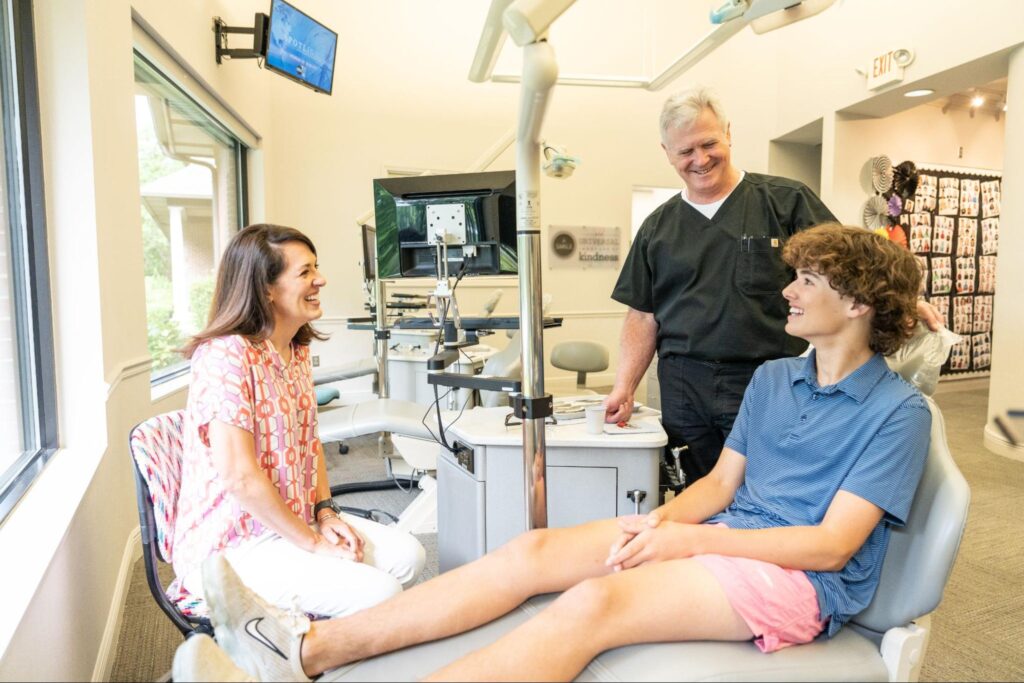
A digital printing workflow helps just about everyone we see at RiverView Orthodontics, though certain situations benefit noticeably more:
- Clear aligner patients. Clear aligners sometimes need refinement trays or a mid-course adjustment. On-site printing keeps those iterations moving.
- Anyone who’s lost or damaged a retainer. This is the single most common fast-turnaround request, and archived files make it simple.
- People with a strong gag reflex. If impression trays have ruined dental visits for you before, digital scanning changes the experience completely.
- Jaw-related and TMJ/TMD cases. Splints and planning models need precision, and printing produces both quickly.
- Athletes. Custom-fit mouthguards printed from your own scan protect better than boil-and-bite versions from a sporting goods store.
- Children, teens, and adults in multi-phase treatment. Longer, staged plans involve more appliances, so faster production adds up across the whole treatment.
Growing kids fit this last group especially well. Early-phase treatment often means expanders and space maintainers timed to growth. When production is fast, timing stays on target.
Frequently Asked Questions About In-House 3D Printing
Is in-house 3D printing safe?
Yes. Appliances that go in your mouth are printed from biocompatible resins cleared by regulators for intraoral use, and every print is washed and UV-cured before delivery. That curing step matters, because it takes the material to full strength and removes uncured residue. Trained team members handle the resins with protective equipment throughout.
How long does a 3D printed retainer take?
Often the same day, sometimes within a few days. A model prints in well under an hour in many cases, then the retainer is thermoformed, trimmed, and polished. Scheduling and lab volume affect the exact timing, so ask what’s realistic for your situation.
Are 3D printed appliances as strong as lab-made ones?
For retainers, aligner models, bonding trays, splints, and mouthguards, printed and thermoformed appliances hold up well in everyday use. Appliances built around soldered metal frameworks are still often fabricated by an outside lab, where those materials are handled best. Your appliance gets matched to whichever method suits it.
Does it hurt or require impressions?
No impression material is needed, and scanning is non-invasive. A small wand passes over your teeth while you sit and watch your smile appear on screen. Most people describe it as easy, and it’s a genuine relief if putty has bothered you in the past. If you’ve been putting off care because of that memory, we totally get your concerns.
Can my old records be reused?
Yes. Stored scan files let us print a remake or replacement without rescanning your mouth, as long as your teeth haven’t shifted significantly since the scan. This is why replacement retainers move so quickly. If teeth have moved, a fresh scan takes only a few minutes.
Does in-house printing shorten overall treatment time?
It shortens waiting, not biology. Teeth move at their own pace, and printing doesn’t change that. What it does eliminate is the shipping and lab-queue delays between steps, which can trim weeks of dead time across a longer case.
Curious how a digital workflow would fit your family? A free consult with Dr. Mike Upton at RiverView Orthodontics comes with no obligation, so you can see the technology up close, ask every question on your list, and get your estimate in writing before anything begins. Your family is our family, and we’d be glad to walk you through it.